Why are high bay LED lights shifting to sensor controls? The answer begins with how industrial spaces are actually used. Warehouses, factories, and sports facilities rarely need maximum illumination in every aisle, bay, or loading zone. Yet traditional systems often keep high bay fixtures operating for long hours, even when shelves are empty or workers have moved elsewhere.
Dr. Peter Boyce, a respected lighting researcher and author, has emphasized, “Lighting is about people, not merely about light.” That principle helps explain the current shift. Occupancy sensors can raise light levels when a forklift enters an aisle and reduce them after the area becomes quiet. Daylight sensors can also respond to skylights, adjusting output near windows during bright afternoons. The result is a more responsive lighting system, not simply a brighter one.
Energy savings are important, but they are not the entire story. Proper controls can reduce unnecessary operating hours, lower heat output, and support longer fixture life. Facility managers also gain useful data about occupancy patterns and maintenance needs. Still, sensor controls are not automatically successful. Poor placement, delayed response times, or incorrect dimming settings can frustrate workers and create dark spots. Small details matter.
Real experience often reveals this gap. A system may perform well in a showroom but behave differently around tall racks, dust, or moving equipment. Therefore, commissioning, testing, and periodic adjustment remain essential. The industry is moving toward smarter high bay lighting, but careful design still determines whether that promise becomes measurable performance.
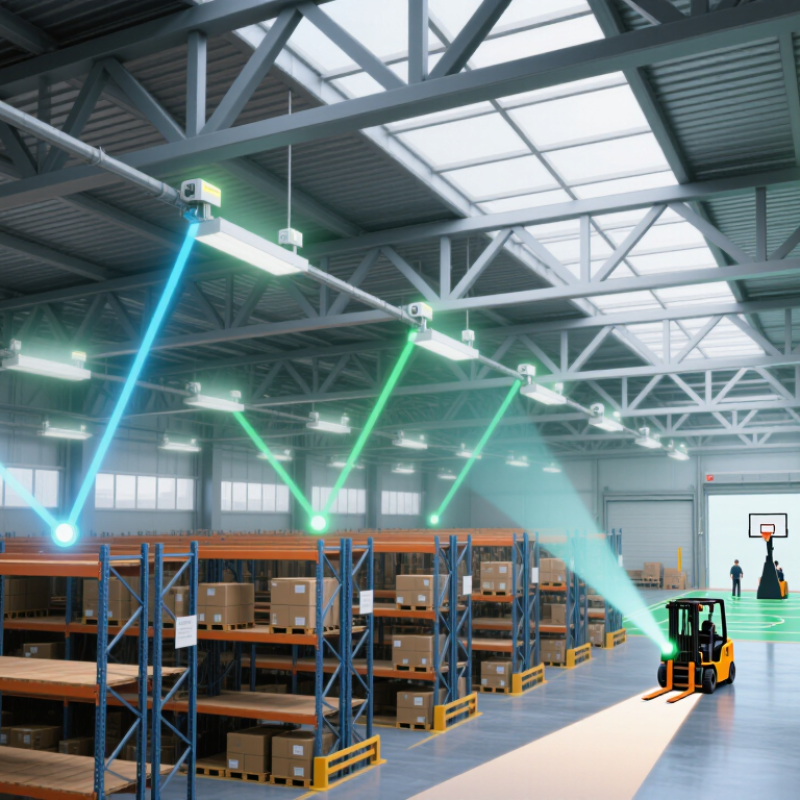
High bay LED lights are powerful ceiling fixtures for spaces with high mounting heights. They are commonly installed 20 to 40 feet above the floor. Typical locations include warehouses, production areas, aircraft hangars, sports halls, and large retail spaces. Their LED modules provide focused, bright light while using less electricity than many older discharge fixtures. They also start instantly, which helps when workers enter a cold, dim aisle. In practice, beam angle matters as much as wattage. A narrow beam can brighten tall shelving. A wide beam may suit open work areas. The wrong choice leaves dark patches.
Sensor controls are devices that adjust lighting according to occupancy, motion, or available daylight. A passive infrared sensor detects body heat and movement. A microwave sensor can notice movement through some lightweight materials, depending on installation. Daylight sensors measure natural light near skylights or windows. These controls can switch fixtures off, reduce output, or raise brightness when activity begins. A warehouse may stay at low output after closing, then brighten an aisle when a worker passes. This can reduce wasted energy without leaving people in darkness.
Good results depend on commissioning, not only efficient fixtures. Installers should check mounting height, detection range, time delay, and dimming behavior on site. A sensor aimed at a swinging door may trigger repeatedly. A long delay can keep an empty zone bright for hours. The result is not always perfect. Dust, shelving, heat, and moving equipment can confuse detection. Facility teams should record complaints, adjust settings, and test dark corners during real work shifts. Reliable control is practical, measured, and less automatic than advertisements suggest.
Why Are High Bay LED Lights Shifting to Sensor Controls?
High bay LED systems are adding sensors because warehouses rarely need full brightness all day. Occupancy sensors detect movement beneath tall ceilings. Daylight sensors adjust output near skylights and loading doors. This creates a more responsive lighting environment.
The U.S. Department of Energy reports that advanced lighting controls can reduce lighting energy use by about 20% to 60%, depending on occupancy, scheduling, and facility design. The range is wide. That matters. In a 30-foot warehouse, unused light may continue shining across empty aisles for hours. Sensors can dim or switch fixtures when workers leave. They can also maintain safer visibility during active tasks. The International Energy Agency has reported that lighting represents a significant share of global electricity demand, making control improvements increasingly relevant.
Tips: Set a practical timeout, not the shortest one. A five-minute delay may frustrate workers near storage racks. A poorly aimed sensor may miss forklift traffic or react to moving equipment. Test coverage at floor level, especially under shelving. Keep emergency lighting and required illumination separate from energy-saving settings. Sensor data can also reveal low-use zones, but facility teams should review the readings instead of trusting automation blindly. A sensor is helpful, not infallible. DOE, Energy Savings Forecast of Solid-State Lighting in General Illumination Applications, and Advanced Lighting Controls guidance provide useful technical references.
High-bay LED lights are shifting toward sensor controls because empty spaces do not need full brightness. In a warehouse, occupancy sensors can dim fixtures above quiet storage lanes. When a worker enters, the lights respond within seconds. This reduces wasted electricity while maintaining safe visibility. Small timing differences matter.
Daylight sensors add another layer of control. They measure light entering through skylights or windows, then adjust fixture output accordingly. A bright afternoon may require only moderate electric lighting. During a cloudy shift, the same system can increase brightness smoothly. Workers experience fewer harsh changes, which can reduce eye strain and improve task accuracy. Energy meters also help facility teams compare expected savings with actual consumption.
Sensors are not perfect. Dust, blocked views, or poorly placed devices can cause delayed responses or unwanted dimming. That assumption is often missed. A practical commissioning check should test aisles, loading areas, corners, and workstations at different times. Settings may need adjustment after observing real movement patterns. Some facilities also use short hold times near safety-critical zones, even when this uses slightly more energy. The best performance comes from matching sensor coverage, dimming levels, and worker habits rather than installing controls and leaving them untouched.
Sensors improve energy efficiency by reducing operating time and lowering light output when areas are unoccupied or sufficient daylight is available.
Modeled annual energy use for a 100-fixture high bay installation. Assumptions: 150 W per LED fixture, 4,000 scheduled operating hours per year, and 60,000 kWh annual energy use without controls. Sensor scenarios represent typical planning assumptions: occupancy sensing reduces operating time by 30%, daylight dimming reduces lighting output by 20%, and combined controls reduce energy use by 45%.
High bay LED lighting is shifting toward sensor controls because large spaces rarely need full brightness all day. Warehouses, workshops, and sports halls often have empty aisles or unused zones. Sensors can reduce wasted energy while maintaining safe visibility for workers and equipment.
Passive infrared sensors detect body heat and movement. They work well in aisles, loading areas, and smaller activity zones. However, stored goods can block their view.
Microwave sensors send radio waves and detect motion through dust, light partitions, and some obstructions. They cover wider areas, but excessive sensitivity may trigger lights unnecessarily.
Ultrasonic sensors measure reflected sound waves. They can identify slower movement, such as sorting or desk work, where infrared detection may miss activity.
Daylight sensors measure available natural light near skylights or windows. They can dim high bay fixtures when sunlight reaches the floor. This requires careful calibration because polished floors, changing weather, and seasonal daylight affect readings. Many systems combine occupancy detection with daylight harvesting and scheduled controls. During commissioning, installers should test detection angles, time delays, dimming levels, and emergency lighting behavior. Small errors matter. A sensor aimed at a moving fan may keep lights active all night. A long delay may also erase expected savings. Better results come from observing real work patterns, not relying only on a factory setting. Sensor control is powerful, but it is not foolproof.
High bay LED lighting is shifting toward sensor controls because warehouses rarely need full output all day. The U.S. Department of Energy reports that LEDs use at least 75% less energy than incandescent lighting and can last up to 25 times longer. Yet fixture efficiency alone does not guarantee savings.
Selection should begin with the space: ceiling height, aisle width, rack layout, daylight, temperature, and dust exposure. A sensor that works well at 30 feet may miss movement at 45 feet. Real sites are messier.
Choose sensing technology according to activity patterns. Microwave sensors can cover tall, open areas, while passive infrared sensors may provide sharper occupancy detection in defined aisles. Dual-technology options can reduce false triggers, but they may increase cost and commissioning time.
Check detection range, mounting height, dimming response, standby power, and adjustable timeout settings. The U.S. Department of Energy’s Energy Savings Forecast of Solid-State Lighting in General Illumination Applications identifies controls as an important factor in extending solid-state lighting savings beyond fixture replacement.
The International Energy Agency’s Energy Efficiency 2023 report also notes that buildings represent about 30% of global final energy consumption, making operational controls significant. A neat specification can still fail.
Walk the floor after installation, record missed detections, and retune scenes around forklifts, cleaning shifts, and occasional overnight work. Human behavior remains unpredictable.
High bay LED lights are powerful ceiling fixtures for spaces with ceilings 20 to 40 feet high. They suit warehouses, production areas, sports halls, and large retail spaces. Their light starts instantly. Beam angle still matters.
A narrow beam can brighten tall shelving and long aisles. A wide beam may suit open work areas. Poor selection can leave dark patches between racks.
Occupancy sensors detect movement or body heat. Fixtures can dim during quiet periods and brighten when workers enter. A dark aisle may light within seconds. That response is useful, but not flawless.
Daylight sensors measure natural light from skylights or windows. They lower electric output during bright afternoons. On cloudy days, they raise brightness gradually. Workers may notice fewer harsh changes.
Microwave sensors can cover tall, open spaces. Passive infrared sensors may work better in defined aisles. Dual-technology sensors can reduce false triggers. They may also cost more and require longer setup.
Check ceiling height, aisle width, rack layout, daylight, dust, and temperature. Review detection range, dimming response, standby power, and timeout settings. A sensor working at 30 feet may miss movement at 45 feet.
Dust, blocked views, shelving, heat, and moving equipment can confuse detection. A sensor facing a swinging door may trigger repeatedly. Missed detections happen. Real buildings are untidy.
Test aisles, loading areas, corners, and workstations during actual shifts. Adjust mounting direction, detection range, timeout, and dimming levels. Record worker complaints and dark spots. A neat installation can still fail.
Why are high bay led lights shifting to sensor controls? High bay LED lights are designed to illuminate large, high-ceiling spaces such as warehouses, factories, gyms, and distribution areas. Sensor controls add intelligent operation by detecting occupancy, motion, daylight, or environmental changes, allowing fixtures to respond to actual lighting needs instead of remaining fully illuminated continuously. This integration can reduce unnecessary energy use while maintaining safe, consistent visibility.
Sensors can improve lighting performance by adjusting brightness, limiting over-lighting, and supporting smoother control across different zones. Common technologies include motion sensors, passive infrared sensors, microwave sensors, ultrasonic sensors, and daylight sensors, each offering different detection ranges and response characteristics. When selecting sensor-controlled high bay LED lights, users should consider ceiling height, coverage area, mounting position, detection accuracy, response time, environmental conditions, dimming compatibility, installation requirements, and long-term maintenance. A well-matched system can balance energy efficiency, user comfort, operational reliability, and the specific demands of the facility.

Lili Light